
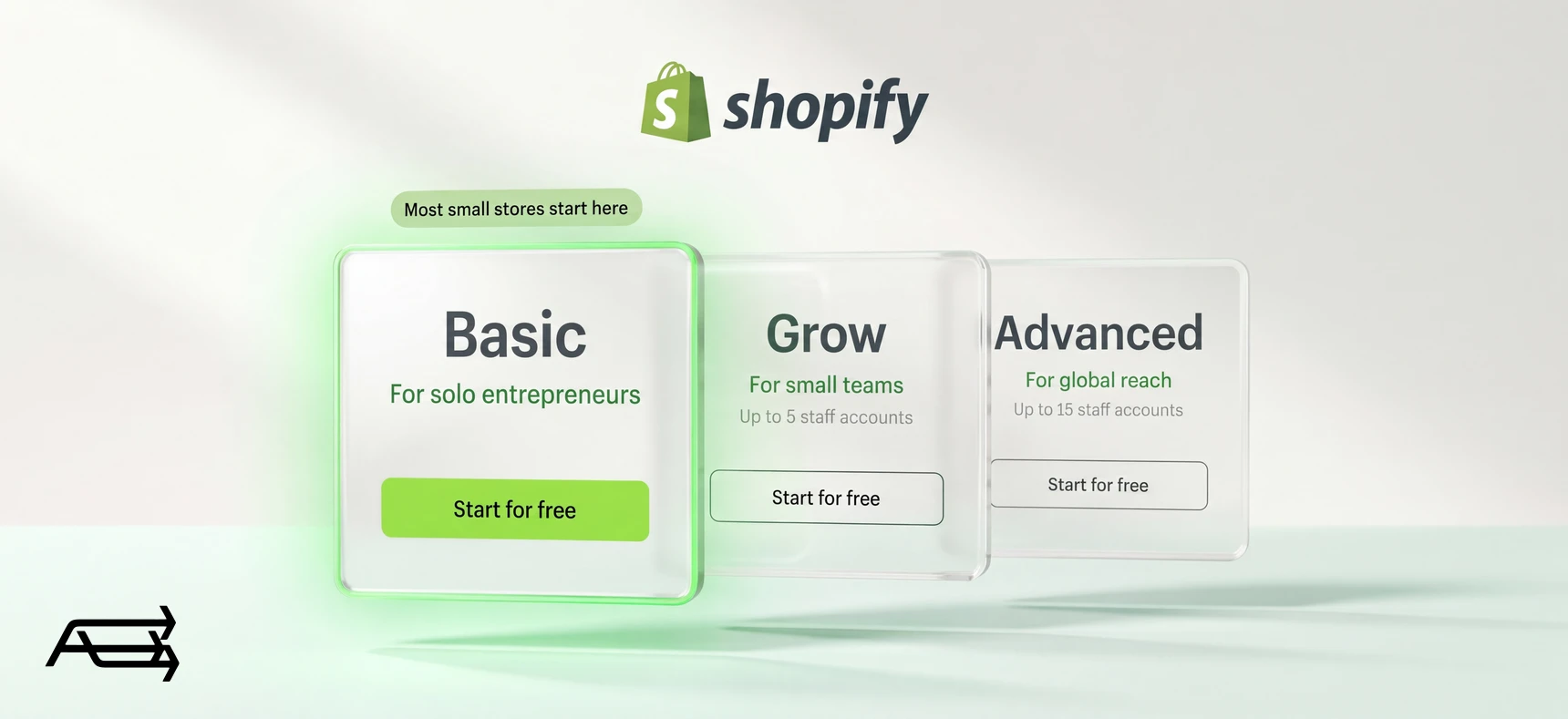
Shopify's pricing page shows four plans, and most guides walk you through every feature of every one. For a small store the real choice is between two of them, and a handful of plain signals decide it. None of those signals is how big you hope the store will get.
In short
- Start on Basic. It runs a full online store, with the same checkout and themes as the plans above it. What it lacks is staff logins and live carrier shipping rates.
- Move to Grow when someone other than you needs their own admin login, or when you need live carrier rates at checkout. Freelancers and agencies don't count: they use collaborator accounts.
- Don't upgrade for the card rate alone. In the US, Grow's lower rate starts to pay for itself at about $300,000 a year in online card sales.
- On 22 September 2026 the offer was three days free, then $1 a month for three months. Starter is closed to new stores.
How to use this guide
Set aside ten minutes. Have three things to hand:
- Your sales. Online sales for the last twelve months, or an honest forecast if you haven't launched.
- Your people. Everyone who needs to log in to the admin, and what they are: an employee, a freelancer, an agency.
- Your shipping. Flat rates you set, free shipping, or live rates from a carrier.
Each plan block below has the same five parts: what it costs, what you get, who it fits, a one-question check, and what to watch out for. After them come the tables, the sum that says when an upgrade pays for itself, and a decision rule by stage.
Every price here comes from Shopify's pricing pages for the US, UK, Canada and Australia, read on 22 September 2026. Shopify changes prices and offers, so open the page for your country before you pay.
What every plan already includes
Before comparing plans, it helps to see what doesn't change. On Shopify's pricing page, Basic, Grow and Advanced all include:
- a full-featured online store, Shopify's themes, and unlimited products
- the same Shopify checkout, with abandoned checkout recovery, discount codes and gift cards
- 200+ real-time reports, plus custom analytics
- selling on social channels and marketplaces
- tools for selling abroad: translations, local currencies, local domains, duties and taxes
- up to ten inventory locations, and collaborator access for a freelancer or an agency
- hosting, a free SSL certificate and your own domain
That's most of what a small store runs on, identical on all three plans. The differences sit in four places: staff logins, shipping rates, the card rate and support.
The three plans a small store chooses between
Basic
What it costs. $39 a month in the US, or $29 if you pay for the year upfront; the other countries are in the table below. With Shopify Payments, a US online card payment costs 2.9% + 30¢. With another payment provider, Shopify adds a 2% transaction fee on top of that provider's own charges.
What you get. Everything in the list above. Shopify labels the plan "For solo entrepreneurs", and that is literal: the store owner is the only full login.
Who it fits. A store that hasn't launched. A store run by one person, with or without a freelancer or an agency helping. A store moving from Wix or Squarespace with one owner behind it.
The check. Does anyone besides you need their own login to the admin as staff, and would live carrier rates at checkout change how you ship? Two noes mean Basic.
Watch out for. Basic includes no staff accounts at all, not even one. Shopify Help's table lists 0 users. Three kinds of access don't count toward that limit, though: the store owner, POS-only staff, and collaborator accounts for Shopify Partners and other freelancers, so an owner working with a designer and a developer can still run on Basic. The other gap is shipping: Basic doesn't support third-party carrier-calculated shipping, so it can't show live UPS, FedEx or USPS rates at checkout.
Grow
What it costs. $105 a month in the US, or $79 paid yearly. The US online card rate drops to 2.7% + 30¢, and the third-party transaction fee drops from 2% to 1%.
What you get. Everything in Basic, plus up to five staff accounts, the lower card rate, and full data access for custom apps built on Shopify's APIs, where Basic has limited access. Live third-party carrier rates are also available: on Grow they are "available for an additional monthly fee, or included with annual billing". Shopify labels the plan "For small teams".
Who it fits. A store where one to five people need their own login: someone packing orders, someone answering customers, a partner running the marketing. Also a store shipping heavy or odd-sized items, where one flat rate either loses money on every parcel or frightens buyers away, and live rates from a carrier would fix it.
The check. Count the people who need their own admin login and aren't collaborators or POS-only staff. One or more means Grow. If live carrier rates are the reason instead, price Grow on yearly billing, where they come included.
Watch out for. Reports. Shopify Help still names advanced reporting as a reason to choose Grow, but on 22 September 2026 the pricing page listed 200+ reports and custom analytics on every plan, Basic included. If a report is your reason to pay more, open it on Basic during the trial first. And the UK pricing table doesn't list live carrier rates on any plan, so a UK store should check with Shopify before paying for them.
Advanced
What it costs. $399 a month in the US, or $299 paid yearly. The US online card rate drops to 2.5% + 30¢, and the third-party transaction fee to 0.6%.
What you get. Everything in Grow, plus up to fifteen staff accounts, live third-party carrier rates included, enhanced 24/7 chat support, higher limits on some APIs, and the option to customise your theme, checkout and customer account pages for each market you sell into. Shopify labels it "For global reach".
Who it fits. A team of six to fifteen people in the admin. Stores selling into several countries that need a different storefront per market. Stores with enough card sales that the rate difference covers the plan (see the sum below).
The check. In the US, Advanced's lower card rate covers its extra cost over Grow at roughly $1.32 million a year in online card sales, on yearly billing. Under that, only the features can justify it.
Watch out for. Shopify Help names "businesses migrating from another platform" as one fit for Advanced, alongside high-volume businesses (Choosing the right plan). For a small store, the move itself doesn't call for it: the online store, the themes and the checkout are the same on every plan. Pick the plan for how the store will run after the move, not for the move.
Two plans a small store can skip
Starter. Comparison guides still recommend Starter as a low-cost way to begin. Shopify Help is direct about it: "The Starter plan isn't available to new stores" (Starter plan). It was built for selling through social media and messaging apps, and merchants on it today can't go back to it once they change plans. Anyone planning around the old $5 price is planning around a closed door.
Plus. From $2,300 a month in the US, labelled "For complex businesses". Not a small store's plan, and not covered by the starting offer.
The three plans at a glance
US prices and rates, read 22 September 2026.
| Basic | Grow | Advanced | |
|---|---|---|---|
| Per month, billed monthly | $39 | $105 | $399 |
| Per month, billed yearly | $29 | $79 | $299 |
| Online card rate, Shopify Payments | 2.9% + 30¢ | 2.7% + 30¢ | 2.5% + 30¢ |
| Fee if you use another payment provider | 2% | 1% | 0.6% |
| Staff accounts | None | 5 | 15 |
| Freelancers and agencies (collaborators) | Included | Included | Included |
| Live third-party carrier rates | Not available | Add-on, or included yearly | Included |
| Support | 24/7 live chat | 24/7 live chat | Enhanced live chat |
| Shopify's own label | For solo entrepreneurs | For small teams | For global reach |
Prices in the UK, Canada and Australia
| Basic | Grow | Advanced | |
|---|---|---|---|
| UK, monthly · yearly | £25 · £19 | £65 · £49 | £344 · £259 |
| UK online card rate | 2% + 25p | 1.7% + 25p | 1.5% + 25p |
| Canada, monthly · yearly (CAD) | $49 · $37 | $132 · $99 | $517 · $389 |
| Canada online card rate | 2.8% + 30¢ | 2.6% + 30¢ | 2.4% + 30¢ |
| Australia, monthly · yearly (AUD) | $56 · $42 | $149 · $114 | $575 · $431 |
| Australia online card rate | 1.7% + 30¢ | 1.55% + 30¢ | 1.35% + 30¢ |
Two things hold in all four countries: the staff limits (none, five, fifteen) and the third-party transaction fees (2%, 1%, 0.6%). Other extras don't. In Canada, the shipping label discount rises with the plan, from up to 45% on Basic to up to 53% on Advanced, while the US page lists the same discount on all three. Read your own country's page, not a guide written for another one.
When does upgrading pay for itself?
A higher plan saves money in one place only: the card rate. Everything else it gives you is a feature you either need or don't. That makes "should I upgrade to save on fees?" a question with an exact answer.
The sum. Take the extra cost of the plan for a year, and divide it by the difference in card rate.
In the US on yearly billing, Grow costs $50 a month more than Basic, so $600 a year, and its card rate is 0.2 points lower. $600 ÷ 0.2% = $300,000. Below $300,000 a year in online card sales, the lower rate doesn't cover the higher price. On monthly billing the line moves to $396,000.
In store terms: a US store selling $5,000 a month saves about $10 a month in card fees on Grow, and pays $50 a month more for the plan.
Where Grow's rate starts to pay, on yearly billing:
| Country | With Shopify Payments | With another payment provider |
|---|---|---|
| US | $300,000 a year | $60,000 a year |
| UK | £120,000 a year | £36,000 a year |
| Canada | $372,000 CAD | $74,400 CAD |
| Australia | $576,000 AUD | $86,400 AUD |
The second column matters if you're moving from another platform and keeping the payment provider you already use. Then the difference between Basic and Grow isn't the card rate, it's the third-party transaction fee (2% against 1%), which adds up several times faster.
Before upgrading for that reason, look at Shopify Payments instead. It's available in all four countries, and with it active, Shopify doesn't charge the third-party fee on Shop Pay, PayPal Express Checkout or manual payments such as cash and bank transfer. One exception: in stores created on or after 12 May 2025, the fee applies to orders paid with store credit or gift cards.
Shopify Help publishes its own break-even estimates and notes that "your actual break-even point may vary". The figures above are ours, from the online card rates on the pricing pages on the day. If much of your business is in person, or on premium and international cards, run the sum with those rates instead.
Monthly or yearly billing?
Paying for the year upfront takes roughly a quarter off every plan in every country we checked. In the US, Basic is $348 a year instead of $468, and Grow is $948 instead of $1,260.
Three things to know before you take it:
- It's charged upfront, for twelve months, at the moment you switch.
- Going back to monthly waits until the end of your annual cycle, however early you ask.
- During the starting offer, a switch to yearly waits too. You keep paying the promotional price each month, and the annual cycle starts, and is charged in full, after the offer ends (Shopify Help).
For a store that hasn't sold anything yet, monthly is the honest choice: take the offer months, then switch to yearly when you're confident the store will still be trading in a year. One exception: if live carrier rates are what you need, yearly billing on Grow includes them.
Which plan for your stage
- Not launched yet. Trial, then Basic on monthly billing, so you use the starting offer.
- Launched, one person running it, with or without a freelancer or agency. Basic.
- Moving from Wix, Squarespace or another platform. Choose by how the store will run after the move. For most small stores that's Basic.
- First hire who needs admin access. Grow, unless they can work as a collaborator or POS-only staff, because neither uses a staff slot.
- You need live carrier rates at checkout. Grow on yearly billing, or Advanced.
- You use a payment provider other than Shopify Payments and sell over about $60,000 a year in the US. Grow pays for itself, but check first whether you can move to Shopify Payments instead.
- Six to fifteen people in the admin, several markets with their own storefronts, or US online card sales above roughly $1.3 million a year. Advanced.
Shopify's starting offer
Checked on 22 September 2026, on the US, UK, Canadian and Australian pricing pages: three days free, then $1 a month for three months (£1 in the UK, and $1 in local currency in Canada and Australia). The three-day trial needs no credit card, and the reduced price that follows is promotional pricing on monthly plans for new merchants. Plus isn't covered by it.
Two details worth planning around. The trial can't be extended, so have your products, photos, policies and domain ready before you start it. The $1 months are the real build period. And if you don't pick a plan by the end of the trial, the store is paused until you do, with your products and settings kept.
New merchants also earn 1% back in subscription credits on Shopify Payments sales in their first six months, capped by plan: in the US, $5,000 on Basic (Shopify Help).
When a bigger plan won't help
A plan buys logins, shipping rates, support and a card rate. It doesn't bring visitors, and it doesn't make them buy. The online store, the themes and the checkout are the same on Basic as on Advanced, so if sales are flat, the plan isn't the reason. Look at the theme, the apps, the product pages, the photos, the speed and where your traffic comes from. That's the work we do, in our Store Design & Theme Development and conversion work.
The money involved is smaller than it feels, too. In the US, the gap between Basic's and Grow's card rate is $2 on every $1,000 you sell. Below the lines in the table above, upgrading to save money costs money.
How to set up your plan, step by step
- Write down the three things from the top of this guide: your sales, your people, your shipping.
- Get the store ready before the trial starts. Product data, photos, policies, domain. The clock starts when you sign up, not when you start working.
- Start the trial. You can try Basic, Grow and Advanced during it, with nothing to pay until it ends.
- Set up payments. Turn on Shopify Payments if you can. Otherwise budget the transaction fee: 2% on Basic, 1% on Grow.
- Pick a plan on monthly billing before the trial ends: Basic, unless your people or your shipping already point at Grow. If you pick nothing, the store pauses.
- Put the end of the offer in your calendar on the day you sign up, and choose monthly or yearly then.
- Set your upgrade trigger and forget about plans until it fires: a hire who needs a login, a shipping problem live carrier rates would fix, or sales crossing the break-even above.
Do it yourself, or hand it to us?
The plan, on your own. A ten-minute decision, and a reversible one: an upgrade takes effect the moment you click it. This guide covers it.
The store, on your own. That's where the time goes. A theme that fits your catalogue rather than a demo, products, photos, payments, shipping and policies set up, and for a move from Wix or Squarespace, products, addresses and rankings landing intact. It's weeks of evenings before the first order, and the $1 months run out while you learn.
What we do. We build the store with you on Basic: a current theme set up with your products and brand, payments, shipping and policies ready, and a test order through checkout before launch. We work through a collaborator account, so it costs you no staff slot and no upgrade, and the work takes us days. That's our Store Design & Theme Development work.
Questions store owners ask
How much does Shopify cost in the first months?
On 22 September 2026: three days free, then $1 a month for three months on monthly billing, then the standard price of your plan. Offers change, so check the pricing page for your country.
Is the Starter plan still an option?
No. Shopify Help says it "isn't available to new stores", and merchants already on it can't return to it once they change plans. Guides that still recommend it as the cheap way in are out of date.
Do I need the Grow plan to let a freelancer or an agency work on my store?
No. Collaborator accounts don't count toward the staff limit, so a designer, a developer or an agency can work on the store while you stay on Basic. Staff accounts are for your own team.
Should I pay monthly or yearly?
Yearly is roughly a quarter less, charged twelve months upfront, and going back to monthly only takes effect at the end of the annual cycle. A new store is usually better off monthly for the first months. On Grow, yearly billing also includes live carrier rates.
Can I change my plan later?
Yes, at any time. Upgrades take effect immediately, billed prorated from the day you switch; downgrades take effect at the end of the current billing cycle. Your products and content aren't affected either way.
I'm moving from Wix or Squarespace. Do I need Advanced?
Almost certainly not. Shopify Help lists Advanced as a fit for businesses migrating from another platform, but that sits alongside high-volume businesses. A small store gets the same online store, themes and checkout on Basic. Choose by staff logins, shipping and sales, as any other store would. What the move itself involves: Wix or Squarespace.
Starting a store, or moving one to Shopify?
Already on Shopify? Send us your store URL for a free Store Audit, sent the same day. Starting out, or moving from Wix or Squarespace? Tell us what you sell, and we reply within one business day with what your store would take.